Keep a loved one's handwriting as a font.
Old letters, recipe cards, the note tucked into a birthday card. HandScript is building a way to turn photos of them into a font you can type with, so their hand can be on the next card, the recipe book, an engraving. It isn't open yet. Leave your email and we'll send one message when it is.
Join the memorial waitlist
One email when memorial fonts open — nothing else. Ask us at support@handscript.app to remove you at any time.
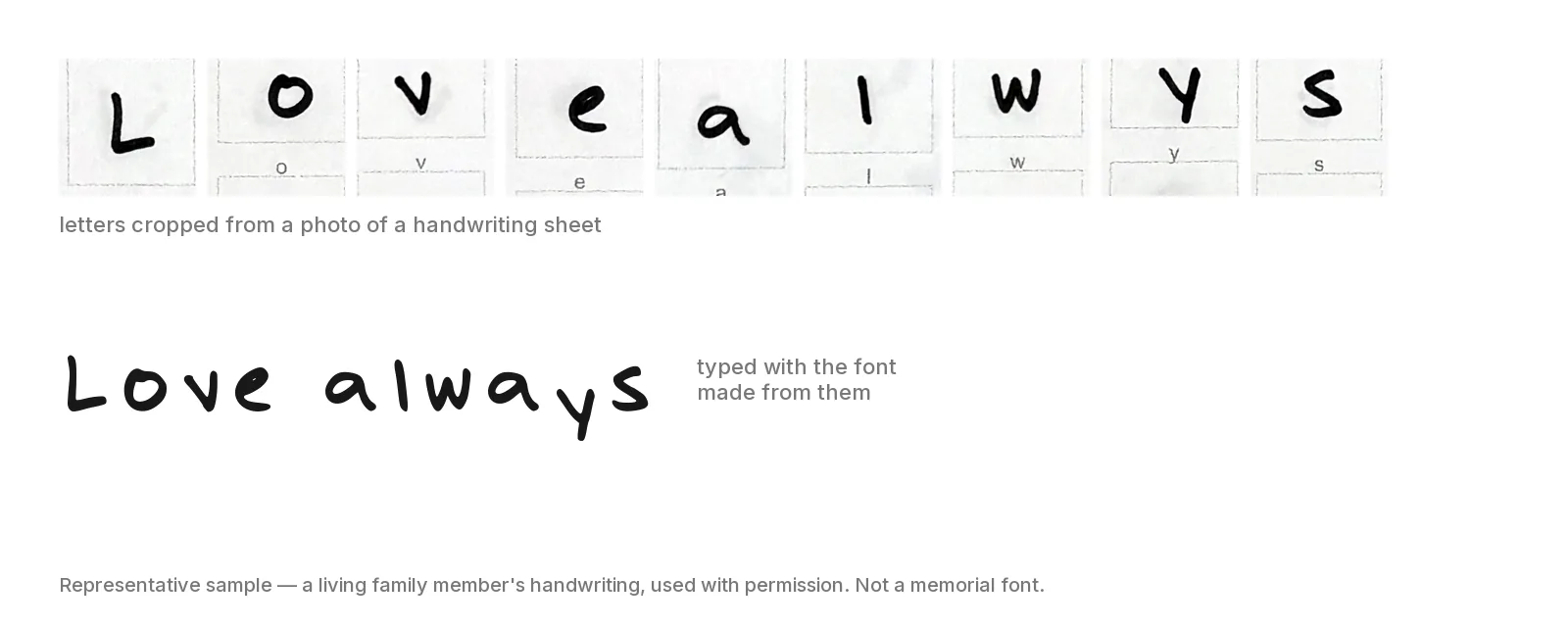
How it will work
A template gives us every character in its own box. A letter doesn't — so memorial fonts take a different, slower path, with you in the middle of it.
Photograph what you have
Letters, cards, recipe cards, journal pages — as many clear pages as you can find (up to ten photos per font to start), in good light, flat, one page per photo. More pages mean more letters found and better choices.We find the characters, you choose
Each photo is read for handwritten characters. For each letter you then see the best-ranked example we found, with up to four alternatives a click away; we pre-select one and you can change it or leave the letter blank. Missing characters are shown plainly, not guessed.Preview, then decide
The chosen examples are traced and assembled into TTF, OTF and WOFF2, and you see a preview sheet before anything is paid for. If it isn't right, nothing is lost but a little time.
The tracing and assembly are the same steps every HandScript font goes through — described on the homepage. What's new, and still being made reliable, is finding characters on a page that was never meant to be a template.
What to gather
If you want to get ready, this is what makes the difference — and none of it needs to be uploaded until the feature opens.
Pages with print, not only cursive
Block or print handwriting separates into characters far better than joined cursive. Lists, envelopes, recipe cards and captions are often the best sources.
Capital letters and digits
Everyday notes are mostly lower case. Addresses, dates and recipe quantities supply capitals and numbers that a single letter won't.
Dark ink on plain paper
Pencil, faded ink and lined or patterned paper make characters harder to find. Photograph the clearest pages first.
Straight-on photos
Lay the page flat, shoot from directly above in daylight or a bright room, keep the whole page in frame. A phone camera is fine — upload the original photo, not a copy saved from a text message, which is often too small to read.
What it's for
A font can't bring back a page. It can put their hand on the things that still get written.
Cards and letters
A line inside a birthday card, a Christmas note, a wedding message from someone who can't be there.
The recipe book
Type out the recipes that only exist on stained index cards, in the hand that wrote them.
Keepsakes and engraving
A name or a short phrase for a locket, a plaque, a Cricut cut — install the font, or give the maker the font file with the text, and they set it like any other font.
Family history
Captions, labels and quotes in scanned albums and printed family histories.
How we'll treat what you upload
Private to your account
The photos and the font are stored in your account and used only to build your font. Nothing is shown to anyone else. The only outside service that looks at what's on the photos is Anthropic's Claude API, which finds the characters; the photos are stored in Supabase and processed on our own font server — all listed in our privacy policy.
Deleted when you say so
Email support@handscript.app from your account's address and we delete the account, the photos and the font. The payment records tax law requires stay with Stripe.
Never sold, never advertising
We don't sell your data or use it for advertising. The processors that handle it are named in our privacy policy.
Your family's handwriting stays your family's
You keep the rights to the handwriting and the photos. You'll confirm at upload that you have the right to use them.
What to know before you start
Will it look exactly like their handwriting?
No, and it's better to know that now. A font repeats each letter the same way every time, so what you get is the shape of their letters — the way they made an “e” or crossed a “t” — not the flow of a particular page. Expect something you would recognise as their letters, and that also reads as typed. It sits beside the real letters; it doesn't replace them.
Joined cursive is the hardest case. Letters that run together can't be cut apart cleanly, so expect fewer usable characters from cursive pages — in the review step you'll see what came out, and you can leave blank any that carry pieces of their neighbours.
What if I only have one letter, or a few cards?
Then the font will have gaps. A single page rarely contains every letter, digit and punctuation mark, and we can't invent the ones that never appear. After the photos are read, you'll see exactly which characters were found and which are missing before anything is built — so you can look for more pages and run it again with the fuller set, or decide the letters you have are enough for what you want to type (a name, a sign-off, a short line).
Why isn't it open yet?
Handwriting on old paper doesn't come in neat boxes. The step that finds each character in a photo of a letter is the hard part, and in our testing it still misses or mis-crops too often to hand to someone at a moment like this. We'd rather open it when it's reliable than let you find out after you've uploaded something precious. The waitlist is one email when it's ready — nothing else.
Is it all right to make a font from someone else's handwriting?
For a loved one who has died, this is a family decision: our terms ask that you only use handwriting that is yours or that you have the right to use, such as a family member's letters with the family's permission, and you'll confirm that when you upload. Making fonts to imitate someone's writing to deceive others is against our terms.
What happens to the photos?
They stay private in your account and are used only to build your font. The only outside service that looks at what's on them is Anthropic's Claude API, which finds the handwritten characters; by default Anthropic doesn't use API data to train its models, and we never opt in. Storage is Supabase and the font is built on our own server. Deletion, no selling, no advertising: see how we'll treat what you upload and our privacy policy.
What will it cost?
We expect the same as any HandScript font: free to make and preview, $9 once to download the files, with a 14-day full refund if it didn't come out the way you hoped. That's not final until memorial fonts open, and the waitlist doesn't commit you to anything.
What can I use the font for?
Anything that takes a normal font, for personal projects — cards, the recipe book, keepsakes for the family; the ideas are in what it's forabove. If you'd sell things made with it, email us first (see our terms). You get TTF, OTF and WOFF2 files; install the font, or give a maker the font file with the text. For a tattoo, an artist can usually work from a scan of the actual handwriting — that needs no font at all.
I have a filled-in HandScript template in their handwriting. Can I use that instead?
Yes — that works today, without waiting. A template sheet gives the pipeline every character in its own box, so it goes through the normal handwriting-to-font flow: upload the photo, check the preview, download.
HandScript is made by Dave (TrustCore Systems). This page was drafted with AI assistance and checked line by line against how the memorial pipeline actually works; Dave is responsible for it and will update it when the feature opens.